top of page

LEADERSHIP STRESS RESPONSE TYPES
What's your type?
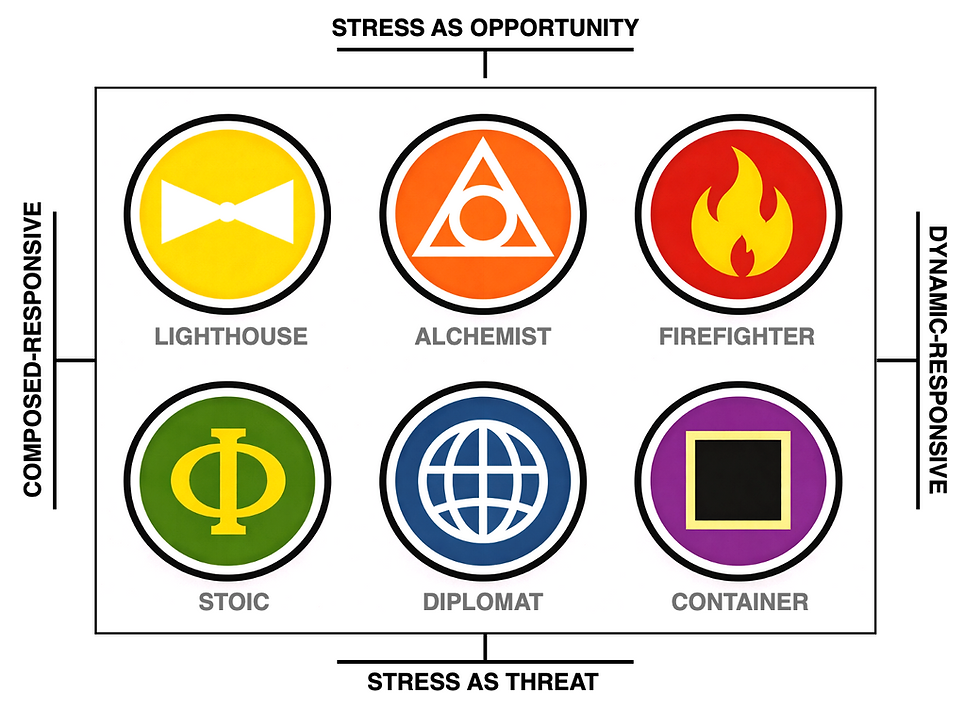
How we respond to stress is shaped by our unique cognitive, psychological and behavioral patterns. Understanding these patterns is the starting point for improving performance under pressure.
CORE PATTERNYou project calm when others are rattled, without losing sight of the long term. Stress triggers your orientation toward stability over speed, and your first rapid appraisal of a new situation is more likely to recognize opportunities than threats. Instead of matching urgency with urgency, you tend to hold your ground and steadily guide others through ambiguity.STRENGTHS UNDER PRESSUREYou create conditions for psychological safety on your team, helping people stay focused and preventing the “emotional contagion of fear.”You keep your eye on the long term, reframing crises as potential opportunities for achieving a future goal rather than short-term threats that might derail you.You give your team something to hold onto: a steady clarity of mind that promotes calm and clear thinking.
ADAPTIVE STRATEGIESExplain your intentions so your calm doesn’t send the wrong signal. Make clear that you are staying steady so everyone can think clearly—not because everything is fine.Don’t let emotional steadiness become emotional distance. Deliberately ask your team how they are feeling and processing the situation, and give them a role in shaping the response.Show visible movement. Your calm can be mistaken for complacency. Take small, concrete actions—decisions, next steps, clear signals of progress—to show that your stability is not masking inertia or indecision.
A QUESTION TO SIT WITHDoes your team know that your steadiness is a deliberate practice to cultivate clear thinking—or do they misread it as complacency or detachment?
CORE PATTERNYou see stress and pressure as a catalyst for growth rather than a threat. You treat turbulence as raw material for invention, responding to it as a signal that the old model no longer fits. Outwardly, you are steady; internally, you are kinetic. You connect dots others don’t yet see. Under duress, you look for possibility, not predictability. You’re the kind of leader who hears, “The playbook doesn’t work anymore,” and replies, “Great—then we get to write a new one.”STRENGTHS UNDER PRESSUREYou listen intelligently to stress as a signal that something needs to change, rather than treating it as a nuisance to be ignored.You thrive in frontier spaces where disruption is the norm—a skill that is becoming more valuable as AI reshapes industry after industry.You help your team maintain momentum, moving forward through the storm rather than hiding from it.ADAPTIVE STRATEGIESFix on a North Star. Know why you’re making a transformation—“because we can” isn’t enough. Be explicit about the problem the change is meant to solve.Create a cadence for change. Avoid running back-to-back transformations that leave your team perpetually in motion. Build in cycles of push and pause, invention and consolidation.Pair creativity with pragmatism. Moderate your instinct toward reinvention by collaborating with people who can organize and execute transformations skillfully.
A QUESTION TO SIT WITHAre you transforming because the situation demands a new model—or because reinvention itself feels more compelling than consolidation?
CORE PATTERNYou thrive on pressure and momentum. You favor decisiveness over prolonged analysis. When a crisis erupts, you move fast, radiate urgency, and mobilize others. You respond to stress dynamically and tend to see it as an opportunity rather than a threat. Pressure doesn’t paralyze you; it ignites you. Often fueled by adrenaline, you restore a sense of empowerment when others freeze. In the short term, this energy can be invaluable: momentum builds, decisions get made, and complexity feels manageable.STRENGTHS UNDER PRESSUREYou embody in extremis leadership. Action itself reassures both you and your team that progress is underway.You bring courage and decisiveness when others hesitate. Your willingness to act creates momentum and restores a sense of agency in moments that might otherwise produce paralysis.You confront problems head-on. You quickly mobilize the people and resources around you to respond proactively to pressure.ADAPTIVE STRATEGIESGet set, then go. Before acting, pause long enough to regulate your nervous system and clarify your intent to the team. A short break can improve the quality of the action that follows.Involve others early. Bring people into decisions sooner so the cognitive load does not sit entirely with you. That helps sustain your energy over time and reduces the risk of burnout.Use after-action reviews. Once the immediate urgency has passed, ask: What worked? What didn’t? What felt productive but actually wasn’t? Reflection turns adrenaline spikes into learning and helps release some of the stress you and your team have been carrying.A QUESTION TO SIT WITHAre you acting because the situation truly requires speed—or because action itself is more comfortable than sitting with uncertainty?
CORE PATTERNYou lead through discipline and self-control. When pressure spikes, you get analytical—anchoring yourself in principles, reason, and what you can control. You may look as calm as a Lighthouse, but the mechanism is different: the Lighthouse uses steadiness to create space for others, while you use it to manage internal volatility. Under stress, you tend to narrow your focus, minimize emotional reactions, and rely on rational analysis to restore stability.STRENGTHS UNDER PRESSUREYou regulate before you react. When a crisis hits, you naturally slow down, manage your emotions, and reintroduce order. Behavioral research suggests this approach can support clearer reasoning under uncertainty.You help your team find the signal in the noise. You focus attention on what can actually be controlled, cutting through distraction and ambiguity.You bring a slow-and-steady discipline to pressure. One step at a time, you maintain composure and forward motion when others are paralyzed by uncertainty.
ADAPTIVE STRATEGIESRegulate, don’t suppress. Steady your own emotional response without pretending it isn’t there. The goal is composure, not emotional shutdown.Make the emotional climate discussable. Name what you sense in the room—“I sense frustration building; let’s explore why”—and practice visible empathy. Even a brief acknowledgment like “I find this decision tough, too” can strengthen trust without surrendering authority.Don’t carry the pressure silently. Acknowledge your own emotions and process them with someone you trust—a coach, peer, or adviser—so stress becomes a source of insight rather than a private load.A QUESTION TO SIT WITHIs your composure helping you engage with the uncomfortable parts of stress—or helping you avoid them?
CORE PATTERNYou lead with tact, using dialogue and connection to ease tension when stress threatens to divide your team. For you, a crisis is as much a social test as a strategic one. Under pressure, you read interpersonal signals closely—sensing tension before it surfaces, defusing conflict, and sustaining trust. Your social intelligence enables what psychologists call relational regulation: helping people manage stress and emotion through connection with others.STRENGTHS UNDER PRESSUREYou preserve cohesion under pressure. You help keep your team from fracturing, protecting the relational capital that most organizations depend on during turbulence.You build coalitions across differences. You don’t shy away from uncomfortable conversations with diverse stakeholder groups, using dialogue to reduce division and sustain alignment.You create space for uncertainty to be voiced. You make it easier for team members to express doubts, fears, and concerns before those feelings harden into disengagement or conflict.ADAPTIVE STRATEGIESSurface tensions instead of smoothing them over. Healthy relationships can tolerate rupture and repair. Say plainly what others sense but won’t voice, creating space for honesty without blame.Build dissent into the process. Use structured debate, premortems, or red-team exercises so disagreement surfaces early and productively rather than going underground.Be clear about where you stand. Your empathy helps others regulate themselves, but under stress they also need direction. Make the objective, your position, and the next steps explicit.A QUESTION TO SIT WITHAre you creating enough trust for people to disagree openly—or are you preserving harmony at the expense of clarity?
CORE PATTERNYou lead with control. Under stress, you impose structure, convert ambiguity into clear priorities, and hold the system together when others are overwhelmed. Like a Firefighter, you respond dynamically, but you are more likely to see stress as a threat than an opportunity. Your instinct is to channel pressure into disciplined execution, often relying on a tight inner circle you can move decisively with while filtering out noise.STRENGTHS UNDER PRESSUREStrong and steady. You take a deliberate, disciplined approach to execution, using the energy you feel from stress to drive toward a tight path forward.You bring clarity to ambiguity. You are a master of process and analysis, helping your team navigate complex crises by turning uncertainty into clear priorities and next steps.You contain stress contagion. You involve only the parts of the organization that need to be involved in a crisis, helping protect everyone else from unnecessary spillover.ADAPTIVE STRATEGIESRelease pressure before it builds too far. Sustained performance depends on more than endurance. Use reflection, feedback, and recovery to reset instead of simply carrying more.Widen the lens. Build regular shifts in perspective into the way your team works so that focus does not become tunnel vision.Model resilience, not invulnerability. Your team takes its cues from you. Make rest and renewal visibly part of performing well under pressure rather than treating them as signs of weakness.A QUESTION TO SIT WITHAre you containing pressure in a way that helps the system function—or carrying so much yourself that you narrow your team’s perspective and capacity?
bottom of page